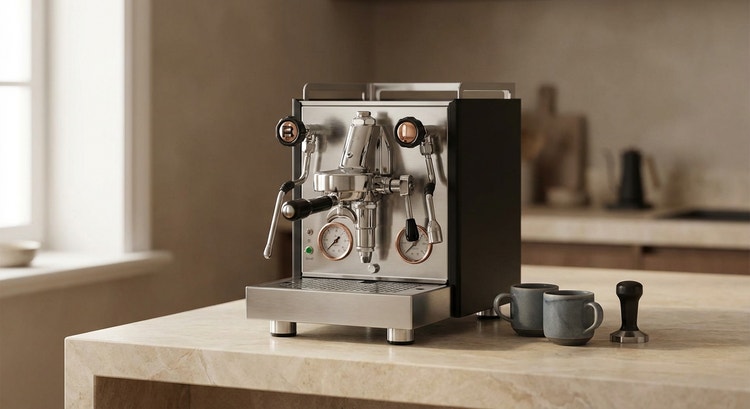
Steaming milk well is the skill that separates a mediocre home latte from a cafe-quality one. It is not about the machine — even an entry-level single-boiler can produce beautiful microfoam if your technique is right. This guide covers the three fundamentals: temperature control, the stretching and texturing phases, and how to use sound as your primary feedback tool.
Temperature: The Window Between Sweet and Scalded
The target temperature for steamed milk is between sixty and sixty-five degrees Celsius (one hundred and forty to one hundred and fifty degrees Fahrenheit). This range is not arbitrary — it is the point at which lactose (milk sugar) reaches its maximum perceived sweetness. Below fifty-five degrees, the milk tastes under-heated and the foam will not hold. Above seventy degrees, the proteins denature irreversibly, the sweetness drops sharply, and the milk takes on a scalded, sulphurous flavour that no amount of latte art can redeem. The most reliable way to gauge temperature as a beginner is by touch. Hold the base of the pitcher with your free hand (the one not holding the pitcher handle). As the milk heats, the base of the pitcher will go from cold to warm to comfortably hot. The moment the pitcher becomes too hot to hold comfortably — when you instinctively want to pull your hand away — is roughly sixty to sixty-five degrees. Stop steaming immediately. This hand-on-the-pitcher method is how most professional baristas work. It is faster and more intuitive than a thermometer once you calibrate your sense of touch over a few sessions. If you prefer precision while learning, a clip-on dial thermometer works well. Attach it to the pitcher so the probe sits in the milk below the foam line, and watch for sixty-two degrees as your stopping point. Account for the fact that the milk will continue rising two to three degrees after you close the steam valve due to residual heat in the wand and pitcher. One critical point: always start with cold milk, ideally straight from the refrigerator at around four degrees Celsius. Cold milk gives you the longest possible steaming window — roughly ten to fifteen seconds of active steaming on a home machine — which is the time you need to incorporate air and create texture before the milk reaches its target temperature.
Stretching vs Texturing: The Two Phases of Steaming
Steaming milk is a two-phase process, and understanding the transition between phases is the key to producing silky, pourable microfoam rather than stiff, bubbly cappuccino foam. Phase one is stretching (also called aerating). This is where you introduce air into the milk to increase its volume. Position the steam wand tip just below the surface of the milk — roughly five to ten millimetres deep — and open the steam valve fully. You should hear a rhythmic chirping or paper-tearing sound as the wand sucks tiny air bubbles into the milk. This sound is your feedback: too loud and aggressive means the tip is too high (it is blasting air in large, coarse bubbles). Too quiet or silent means the tip is too deep (no air is being incorporated). The sweet spot is a gentle, consistent tss-tss-tss that introduces fine bubbles at a controlled rate. Stretching should last only two to four seconds for a latte or flat white, during which the milk volume increases by roughly twenty to thirty percent. For a cappuccino, stretch for four to six seconds to build a thicker foam layer. If you stretch too long, you will create too much foam and the milk will feel dry and frothy rather than silky. Phase two is texturing (also called spinning or polishing). After stretching, lower the wand tip deeper into the milk — roughly one to two centimetres below the surface — and angle the pitcher so the steam creates a vortex, a spinning whirlpool visible on the milk's surface. This vortex breaks the larger bubbles created during stretching into increasingly smaller microbubbles and distributes them evenly throughout the milk. The sound during texturing should be a smooth, quiet hum with no chirping — just the sound of milk spinning. Continue texturing until the pitcher reaches your target temperature. The vortex is doing the critical work: it is folding the foam into the liquid milk, creating a homogeneous mixture with a uniform, glossy texture that pours like wet paint. Without this spinning phase, you end up with a layer of dry foam sitting on top of thin, hot milk — the dreaded two-layer cappuccino.
The Sound of Good Steam: Using Your Ears to Diagnose Problems
Sound is the most reliable real-time feedback tool for milk steaming, more useful than sight or touch during the actual process. Learning what good steaming sounds like — and recognising the sounds of common mistakes — will accelerate your progress faster than any amount of theory. Good stretching sounds like a rhythmic, gentle chirping: tss-tss-tss. Each chirp represents a small injection of air. The chirps should be even and consistent, indicating that air is entering the milk in controlled, uniform quantities. If the chirps are irregular or explosive (a loud TSSS followed by silence), the wand tip is bouncing in and out of the milk surface. Stabilise your hand and find a consistent depth. A screaming or shrieking sound means the wand tip is completely above the milk surface and blasting air chaotically. This creates large bubbles that are impossible to texture into microfoam. Immediately lower the pitcher to submerge the tip. Silence during the stretching phase means the tip is too deep. No air is being incorporated, so you are heating the milk without adding any foam. Raise the pitcher slightly until you hear the chirping resume. Good texturing sounds like a deep, smooth hum — almost like a distant washing machine. There should be no chirping (the tip is below the surface, no longer introducing air) and no screaming (the tip is deep enough to avoid turbulence). The hum indicates that the milk is spinning in a tight vortex and the microbubbles are being evenly distributed. A gurgling or bubbling sound during texturing means the vortex is not established — the steam is pushing milk around randomly rather than spinning it in an organised circle. Adjust the angle of the pitcher and the position of the wand tip until the gurgling resolves into a smooth hum. With practice, you will learn to steer the entire steaming process by ear alone, glancing at the milk only to confirm the glossy, paint-like surface that indicates properly textured microfoam. Most baristas will tell you they could steam milk with their eyes closed. It is the ear, not the eye, that matters most.
Common Steaming Faults and How to Fix Them
Even with solid technique, several common faults can derail your milk steaming. Knowing how to diagnose and fix each one will save you countless jugs of wasted milk. The most frequent fault is too much foam. This happens when you stretch too long during phase one, incorporating more air than you can texture into the milk before it reaches temperature. The result is a thick, dry cap of foam sitting on top of thin liquid — unusable for latte art and unpleasant to drink. The fix is simple: reduce your stretching time. For a flat white or latte, two to three seconds of stretching is enough. Time yourself until the muscle memory develops. The second most common fault is large, visible bubbles on the surface. These are caused by introducing air too aggressively — the wand tip is too high, the steam pressure is too strong, or the chirping phase is too violent. To fix this, start with the tip barely below the surface and focus on gentle, rhythmic chirping rather than loud blasts. If large bubbles form despite good technique, you can break them by tapping the base of the pitcher firmly on the counter after steaming and swirling the milk vigorously. This is a rescue technique, not a substitute for proper stretching. Scalded milk — recognisable by its dulled sweetness and slightly sulphurous smell — means you overshot the temperature window. The fix is to stop steaming earlier. Use the hand-on-pitcher method and stop the moment the base becomes uncomfortably hot. If you consistently overshoot, your starting milk temperature may be too warm (use milk straight from the fridge) or you may be using too much steam pressure on a machine that allows pressure adjustment. Finally, thin, watery milk with no foam means you skipped or shortened the stretching phase. Without air incorporation, steaming just heats the milk without changing its texture. Make sure you hear the chirping sound during the first two to four seconds before submerging the tip for texturing. Every steaming session is practice, and the learning curve is faster than most people expect. Within a week of daily practice, most home baristas can produce consistently pourable microfoam.
Key Takeaways
- Target temperature is 60–65 C. Use the hand-on-pitcher method: stop steaming when the base becomes too hot to hold comfortably.
- Steaming has two phases: stretching (introducing air with a chirping sound, 2–4 seconds) and texturing (spinning a vortex with a smooth hum, until temperature is reached).
- Sound is your most important feedback tool. Chirping means air is entering. A smooth hum means the vortex is spinning. Screaming means the tip is too high.
- Always start with cold milk from the fridge to maximise your steaming window.
- The most common fault is too much foam from stretching too long. Reduce stretching time to 2–3 seconds for lattes and flat whites.