Understanding the Pressure Curve: Reading What Your Machine Is Telling You
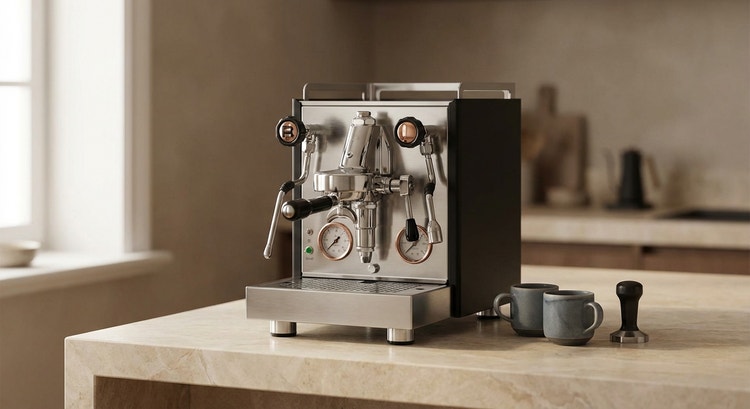
A pressure gauge is more than a decoration on the front of your machine. It is a real-time diagnostic tool that reveals how water and coffee are interacting inside the group head. Learning to read the pressure curve — how pressure changes from the moment you start the pump to the moment you stop it — gives you insight into puck condition, extraction quality, and what to adjust next.
What the Pressure Curve Shows You
The pressure curve is a plot of brew pressure over time during a shot. On a machine with a gauge, you can watch this curve unfold in real time. On machines with digital displays or connected apps, the curve is often logged and shown as a graph after the shot. A typical curve has three phases. The first phase is the ramp-up: pressure climbs from zero to the machine's set point as the pump engages and water fills the group head and saturates the puck. How quickly pressure builds depends on the pump type, whether pre-infusion is active, and how resistant the puck is. The second phase is the plateau: pressure stabilizes near the set point — usually around 8 to 9 bars — as water flows steadily through the puck. The gauge may fluctuate slightly, which is normal, but large swings indicate problems. The third phase is the decline: as the puck erodes and becomes less resistant, pressure may naturally drop slightly toward the end of the shot, especially on machines without volumetric pumps. On a manual profiling machine, you may intentionally reduce pressure during this phase. Each phase tells you something different about puck condition and extraction quality, and learning to interpret them is a significant step in your espresso education.
What Deviations From the Ideal Curve Mean
An ideal pressure curve builds smoothly to the set point, holds steady, and declines gently. Deviations from this pattern are diagnostic signals. If pressure builds very slowly during the ramp-up and struggles to reach 9 bars, the puck is offering too little resistance — the grind is too coarse or the dose is too low. Water is finding easy paths through the coffee, and the pump cannot build pressure against such low resistance. You will likely see a fast, under-extracted shot. Conversely, if pressure spikes rapidly above 9 bars and the over-pressure valve engages, the puck is too dense — the grind is too fine or the dose is too high. Water cannot flow, the shot chokes, and extraction becomes uneven and harsh. If the plateau phase shows sudden drops or spikes rather than a steady hold, channeling is likely occurring. A sudden drop means the puck has fractured and water has found a shortcut; a spike means a channel has closed and pressure has momentarily built up. Either way, the puck is not uniform, and you should review your distribution and tamping. If the decline phase is precipitous — pressure falls from 9 bars to 3 bars rapidly — the puck has become exhausted and fragmented, which often means the shot has run too long or the dose was too low for the yield.
Diagnosing Puck Preparation from the Curve
One of the most powerful uses of the pressure curve is diagnosing puck preparation quality. A well-prepared puck — evenly distributed, properly tamped, free of clumps — produces a smooth, stable curve. The ramp-up is predictable, the plateau is flat, and the decline is gradual. Compare this to a poorly prepared puck with clumps, an uneven surface, or a tilted tamp. The curve will show irregularities: a bumpy ramp-up as water finds and fills voids, an unstable plateau with pressure fluctuations as channels open and close, and an abrupt decline as the weakened puck breaks apart. If you consistently see an unstable plateau despite using the same grind and dose, the problem is almost certainly in your distribution. Introduce a WDT step to break up clumps, use a leveling tool before tamping, and ensure your tamp is straight and level. Then compare the curves. You should see the plateau smooth out noticeably. If you see a consistently slow ramp-up followed by a sudden jump to full pressure, your pre-infusion may be too long or your machine may have a hesitation in its pump cycle. Time the phases: a normal ramp-up without pre-infusion should take 3 to 5 seconds to reach the set point. Anything significantly longer or shorter warrants investigation.
Using the Curve to Iterate on Recipes
Once you can read a pressure curve, you can use it alongside taste to iterate on your recipe more efficiently. Taste tells you what the outcome is; the curve tells you why. For example, if a shot tastes sour and you notice the plateau phase is shorter than usual with an early pressure drop, the puck may have channeled, causing localized under-extraction even though total shot time was in range. The fix is puck prep, not grind adjustment. If a shot tastes balanced but the curve shows an excessively long ramp-up, you might be using more pre-infusion than necessary — the flavor is fine, but you could get there faster and more efficiently. If you are experimenting with pressure profiling, the curve is essential for verifying that your machine is executing the profile you intend. Program a declining profile and confirm on the gauge or log that pressure actually decreases — some machines have pump lag or valve delays that distort the intended curve. The discipline of reading the curve after every shot, not just tasting the result, gives you twice the information and makes your adjustments more targeted. It is the difference between guessing and diagnosing, and it transforms the feedback loop from intuition-based to evidence-based.
Key Takeaways
- The pressure curve has three phases — ramp-up, plateau, and decline — each revealing different information about the extraction.
- A slow ramp-up suggests too little puck resistance (coarse grind or low dose); a rapid spike suggests too much (fine grind or high dose).
- Plateau instability — drops and spikes — is a strong indicator of channeling caused by poor puck preparation.
- Compare curves across shots with the same recipe to isolate the effect of puck prep changes versus grind changes.
- Use the pressure curve alongside taste to diagnose not just what went wrong but why.
Related Products