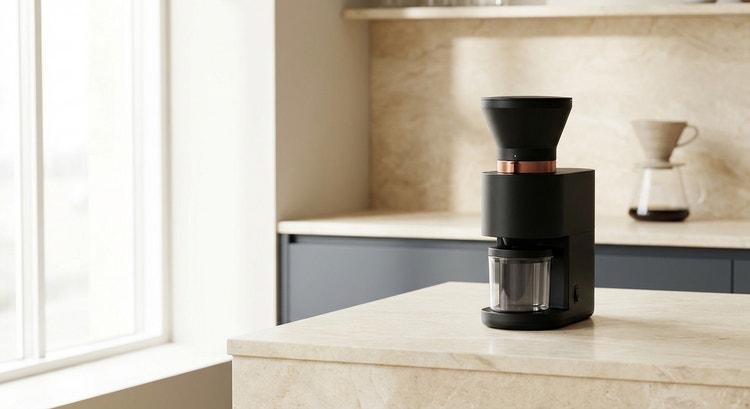
The Arco Filtro was designed to handle the full range of filter grind sizes, from the fine end needed for AeroPress to the coarse territory required by French Press and cold brew. But dialling in the right setting for each method takes more than guesswork. This guide provides tested starting points for five popular brewing methods and explains the logic behind each recommendation.
Understanding the Filtro's Grind Range
The Arco Filtro uses a stepped adjustment system with clearly numbered settings that span the entire filter spectrum. Unlike espresso grinders, which concentrate their adjustment range across a narrow band of very fine particles, the Filtro spaces its steps across medium-fine through coarse. Each step produces a meaningful change in particle size — typically around fifty to seventy microns between adjacent settings — which translates to a noticeable difference in extraction time and cup character. The stepped design is intentional for filter brewing. Once you find a setting that works for your V60 recipe, you can return to it reliably every time without the drift that can occur with stepless grinders. The burr geometry is optimised for the larger particle sizes filter demands, producing fewer fines (tiny dust-like particles that over-extract and cause bitterness) and more uniform particles in the target range. This consistency is what separates a purpose-built filter grinder from a general-purpose grinder with the range turned up. Before dialling in for any method, run five to ten grams of coffee through the grinder at your approximate target setting and discard it. This purges any retained grounds from your previous session and ensures the particles in your brew dose are uniform. The Filtro's low retention design means this purge amount is small, but it is still good practice when switching between vastly different settings — say, from AeroPress fine to French Press coarse.
V60 and Chemex: Medium-Fine to Medium
The V60 and Chemex are both pour-over brewers, but they use different filter thicknesses that affect flow rate and extraction, so they benefit from slightly different grind settings on the Filtro. For the Hario V60 with a standard tabbed paper filter, start at setting 14 on the Filtro. The V60's large single drain hole and thin filter paper mean water flows through the bed relatively quickly, so you need a finer grind to achieve adequate contact time. A fifteen-gram dose with two hundred and fifty grams of water should yield a total brew time of around two minutes thirty seconds to three minutes. If your drawdown finishes before two minutes fifteen seconds, go one step finer. If it drags past three minutes fifteen seconds, go one step coarser. The Chemex uses a substantially thicker bonded paper filter that slows flow rate on its own. Start at setting 16 on the Filtro — two steps coarser than the V60 starting point. A thirty-gram dose with five hundred grams of water (the Chemex's sweet spot for two servings) should finish in roughly three minutes thirty seconds to four minutes fifteen seconds. The thicker Chemex filter also absorbs more oils than a V60 filter, producing an even cleaner cup. If your Chemex brew tastes thin or sour, move one step finer. If it tastes bitter or astringent, move one step coarser. With both methods, the Filtro's low-fines output means your paper filter is less likely to clog, giving you a more predictable drawdown and a sweeter, cleaner cup.
AeroPress: The Finer End of Filter
The AeroPress occupies an interesting position between filter and espresso — it uses pressure (albeit gentle, human-powered pressure) to push water through the coffee bed, which means it can extract effectively from a finer grind than gravity-only methods. On the Filtro, start at setting 10 for a standard AeroPress recipe with a paper filter. This is finer than any pour-over setting but still well within the Filtro's designed range. A typical recipe uses fifteen grams of coffee, two hundred grams of water at about eighty-five degrees Celsius, a one-minute steep, and a thirty-second press. The finer grind combined with the immersion steep produces a cup with more body than a pour-over but more clarity than a French Press — a balance that has made the AeroPress enormously popular. If you use the inverted method (flipping the AeroPress upside down to prevent any drip-through during steeping), you can experiment with going one step coarser to setting 11, because the full immersion time compensates for the slightly larger particles. For a more concentrated, espresso-style AeroPress brew, try setting 8 with a metal filter disc, a shorter steep of forty-five seconds, and a firm press. This will not produce true espresso — you cannot match nine bars of machine pressure with your arms — but it yields a rich, concentrated shot that works as a base for a small milk drink. The Filtro handles this finer setting well because its filter-optimised burrs still produce uniform particles even at the lower end of their range, avoiding the excessive fines that would make pressing painfully difficult.
French Press: Going Coarse Without Going Muddy
French Press requires the coarsest grind of any common brewing method because the metal mesh filter does not stop fine particles — they pass straight through into your cup, creating sludge and over-extraction. On the Filtro, start at setting 22 for a standard four-minute French Press brew. A thirty-gram dose with five hundred grams of water at about ninety-six degrees Celsius is the classic recipe. What matters most at this setting is uniformity. A cheap blade grinder set to coarse produces a mix of boulders and dust: the boulders under-extract (sour, grassy) while the dust over-extracts (bitter, ashy). The Filtro's burrs cut the beans into relatively uniform coarse particles, which means the extraction is even across the entire dose. The result is a French Press cup that is full-bodied and rich but noticeably sweeter and cleaner than what most people expect from the method. If your French Press coffee tastes flat or watery, move one step finer to setting 21. If it tastes harsh or gritty, move one step coarser to 23. You can also try the James Hoffmann French Press technique — a longer steep of four minutes followed by removing the crust, then waiting another five to six minutes before gently pressing and pouring without plunging all the way down. This method benefits from a slightly finer setting (20 or 21 on the Filtro) because the extended contact time and gentle handling reduce the impact of fine particles.
Cold Brew: The Coarsest Setting with the Longest Steep
Cold brew extraction happens slowly because cold water is far less effective as a solvent than hot water. To compensate, cold brew uses a very coarse grind, a high coffee-to-water ratio, and a steep time of twelve to twenty-four hours. On the Filtro, start at setting 25 — the coarsest end of the practical range. Use a ratio of roughly one to eight by weight: seventy-five grams of coffee to six hundred grams of cold filtered water. Steep in the refrigerator for sixteen to eighteen hours, then strain through a fine mesh sieve lined with a paper filter or cheesecloth. The resulting concentrate is smooth, low in acidity, and naturally sweet. You can dilute it one-to-one with water or milk for a refreshing iced coffee, or drink it straight if you prefer intensity. The Filtro's uniform coarse grind is especially important for cold brew because the long steep time magnifies any inconsistency. Fine particles in a twelve-hour immersion will over-extract dramatically, adding bitterness and harshness to what should be a mellow, smooth drink. With the Filtro set to 25, you get large, even particles that extract gently and predictably over the long steep, yielding a concentrate that tastes clean and sweet with none of the muddy astringency that plagues cold brew made with inconsistent grinds. If you find your cold brew too mild after eighteen hours, try setting 24 before increasing steep time — a slightly finer grind will increase extraction more predictably than simply leaving the coffee in water longer, which risks pulling out unpleasant woody and papery compounds.
Key Takeaways
- V60 starting point: setting 14. Chemex: setting 16. Adjust by one step based on drawdown time.
- AeroPress: setting 10 for standard recipes, setting 8 for concentrated espresso-style brews.
- French Press: setting 22. Grind uniformity matters more here than with any other method.
- Cold brew: setting 25 with a 16–18 hour steep. The coarse, uniform grind prevents bitterness over long extraction.
- Always purge 5–10 grams when switching between significantly different grind settings.
Related Products