Lever Espresso vs. Pump Espresso: History, Mechanics, and Flavor
The lever machine came first — Achille Gaggia's 1948 patent replaced steam pressure with a spring-loaded piston and gave birth to modern espresso as we know it, crema and all. The electric pump machine followed in 1961, replacing human force with motorized consistency. Both approaches produce genuine espresso, but they differ profoundly in how pressure is generated, how the barista interacts with the extraction, and what ends up in the cup.
A Brief History of Espresso Machines
Before 1948, espresso was made by forcing steam or heated water through coffee at relatively low pressure — typically 1.5 to 2 bars. The resulting drink was strong and concentrated but lacked the crema, body, and flavor complexity we associate with modern espresso. Achille Gaggia changed everything with a spring-piston mechanism. The barista pulled a large lever down, compressing a powerful spring. Releasing the lever allowed the spring to push a piston upward (or downward, depending on the design), forcing hot water through the coffee at 8 to 10 bars of pressure. For the first time, this high-pressure extraction emulsified the coffee's oils and CO2 into a thick, persistent foam — crema. Gaggia marketed this foam as 'crema naturale di caffe,' and espresso as we know it was born. For the next 13 years, every espresso machine was a lever machine. Then in 1961, the Faema E61 introduced a motorized rotary pump that generated continuous pressure without requiring the barista to pull a lever for every shot. The E61 also introduced the thermosyphon group head, which maintained stable brew temperature through natural water circulation. The pump machine's advantages were consistency and reduced physical effort — a busy barista could pull hundreds of shots without fatiguing. Over the following decades, pump machines became the global standard, and lever machines retreated to a niche of enthusiasts and traditionalists.
How Lever Machines Work
There are two types of lever machines: spring lever and direct lever. Spring lever machines — the Gaggia type — use a spring that the barista compresses by pulling the lever down. Hot water fills the brew chamber while the lever is down. When the barista releases the lever, the spring pushes the piston, forcing water through the puck. The pressure starts high (8 to 10 bars as the spring is fully compressed) and naturally declines as the spring relaxes, ending the shot at 2 to 4 bars. This declining pressure profile is inherent to the design and is one of the defining characteristics of lever espresso. Direct lever machines — like the La Pavoni Europiccola or the Olympia Cremina — have no spring. The barista pushes the lever down manually, and the force of their arm creates the brew pressure. This gives the barista complete control over pressure at every point in the shot, but it requires practice and physical calibration. A consistent 9-bar push requires about 20 to 30 kilograms of force on the lever, depending on the lever ratio and piston diameter. Both types produce espresso with a distinctive character: the declining pressure profile (natural in spring levers, intentional in direct levers) typically yields a shot that is sweeter in the finish, with a rounder body and less of the lingering bitterness that can accompany the constant-pressure extraction of a pump machine. The trade-off is consistency — lever shots are more variable than pump shots, especially for beginners.
Flavor Differences Between Lever and Pump
The most commonly cited flavor difference between lever and pump espresso is the finish. Lever shots, with their naturally declining pressure, tend to have a cleaner, sweeter aftertaste. Because pressure drops toward the end of the shot, less of the bitter, heavy compounds are extracted in the final seconds — the water is moving through the weakening puck more gently, pulling fewer harsh solubles. Pump shots, which maintain constant pressure until the barista stops the pump, continue extracting at full force all the way to the end, including those bitter late-stage compounds. This can produce a shot with more intensity and body but also more bitterness in the finish. Body is another point of differentiation. Lever shots often have a silkier, more viscous mouthfeel. The declining pressure allows oils and fine suspended particles to remain more evenly distributed in the liquid, contributing to what many describe as a 'velvety' texture. Pump shots can have a slightly thinner body at the same recipe, though this varies with machine design. Acidity expression also differs. The high initial pressure of a spring lever pushes through the puck aggressively at the start, extracting bright acids quickly, then backs off. The result can be a more focused, brighter acidity compared to the more evenly distributed acid extraction of a constant-pressure pump. None of these differences are absolute — a skilled barista can produce extraordinary espresso on either platform. But the character signatures are real and worth experiencing side by side if you ever have the opportunity.
Arco's Pump Approach and What It Borrows from Lever Tradition
Arco builds pump-driven espresso machines, and there are good reasons for that choice. Pump machines offer repeatable, electronically controlled extraction that does not depend on the barista's physical strength or lever technique. They heat up faster, require less physical effort, and are more accessible to beginners. For the morning-minimalist persona — someone who wants excellent espresso without a steep learning curve — a pump machine is the right tool. But Arco's design philosophy draws inspiration from lever tradition. The Arco Doppio's adjustable over-pressure valve (OPV) lets you reduce the brew pressure from the standard 9 bars to as low as 6 bars, enabling a pseudo-declining profile: you can start a shot at 9 bars and manually reduce pressure partway through by adjusting the OPV during extraction, mimicking the natural pressure decline of a spring lever. This is not the same as a true lever experience — the haptic feedback, the mechanical intimacy, the shot-to-shot variation that lever devotees love — but it captures the flavor benefits of declining pressure within a modern, accessible, pump-driven platform. The Arco philosophy is that the best espresso comes from understanding principles, not from fetishizing a specific mechanism. Lever machines teach us that pressure does not need to be constant, that a gentle finish produces sweeter shots, and that the barista's engagement with the machine matters. These lessons inform Arco's machine design even though the motor, not a spring, does the work.
Key Takeaways
- Lever machines use a spring or manual piston to create pressure; pump machines use an electric motor — both produce genuine espresso.
- Lever espresso has a naturally declining pressure profile that produces sweeter finishes and silkier body.
- Pump espresso offers greater consistency and accessibility, especially for beginners and busy mornings.
- The Arco Doppio's adjustable OPV lets you approximate a declining pressure curve on a pump platform.
- The lever tradition teaches that variable pressure during extraction produces different — often sweeter — flavor profiles.
Related Products
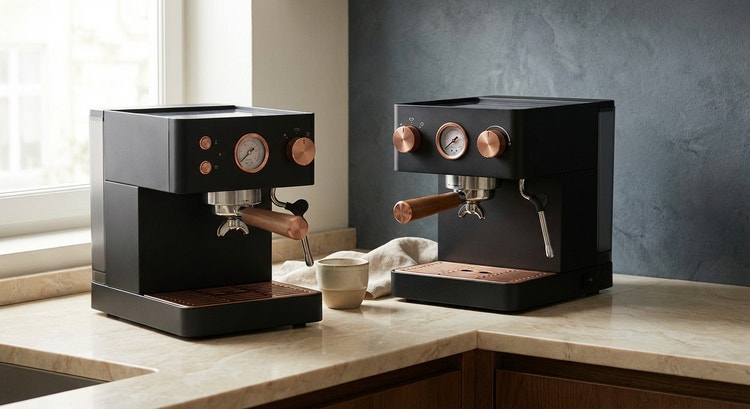
Arco Primo