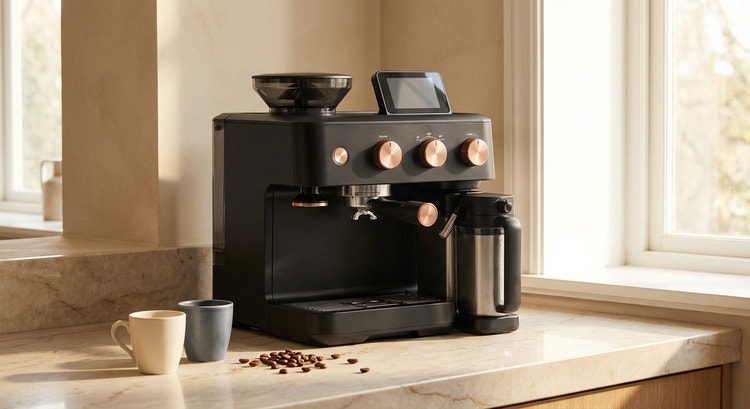
Great espresso when the stakes feel high.
They are judging the coffee. You know it. The machine does not care.
Your partner's parents are coming for lunch. They are Italian, or they lived in Melbourne for a decade, or they simply have opinions about coffee that they express with the directness of people who have been drinking espresso since before you were born. The meal you can handle. The conversation you can survive. But the coffee — the post-lunch espresso that will either confirm you as a competent adult or expose you as someone who does not understand the basics — that is where the pressure lives.
The first time they visited, you did not have a proper machine. You had a French press and good intentions, and when your mother-in-law politely declined the coffee you offered and then made herself a cup of instant from a jar she found in the back of the cupboard, you understood two things. First, that she would rather drink bad coffee she made herself than mediocre coffee you made for her. Second, that the coffee question was never going to go away.Your partner tried to reassure you. 'They don't care about the coffee,' they said, which was demonstrably false. Your father-in-law had mentioned, over Christmas dinner, that the espresso at your local cafe was 'not terrible,' which your partner later translated as the highest compliment he had ever given a non-Italian establishment. These are people for whom coffee is not a beverage but a value system. Getting it right matters.The Arco Automatico was the solution, and it was the right one precisely because it removed you from the equation. You are not a barista. You do not want to be a barista. You do not want to learn about extraction theory, grind distribution, or the optimal temperature curve for a medium-dark blend. You want to press a button and have something come out that makes your in-laws nod with approval instead of exchanging the glance — the glance that says, without words, that their child could have married someone who understands coffee.The Automatico does not require your skill. It requires your beans. This is the insight that changed everything. The machine handles the grinding, dosing, tamping, and extraction automatically, adjusting its internal grinder based on bean density. What it cannot do is compensate for bad beans. So you found a roaster — a proper one, not a supermarket brand — and you buy a bag of their espresso blend every two weeks. The beans go into the hopper. The machine does the rest.The second time the in-laws visited, you made espresso after lunch. Four cups. You pressed the short button four times, placed the cups on a tray, and carried them to the table. Your mother-in-law took a sip. She did not say anything. She took a second sip. Then she looked at you and said, 'This is good.' Two words. Your partner, who had been watching from across the table with the tension of someone defusing a bomb, exhaled audibly.Your father-in-law asked what machine you were using. You told him. He made a sound — a kind of appreciative grunt — and said that his cousin in Bergamo had one and spoke well of it. From your father-in-law, this was the equivalent of a standing ovation. He finished his espresso, accepted a second, and the conversation moved on to other things. You had passed.The Automatico has since become your quiet ally in every family visit. It sits on the counter, unassuming, and when the moment arrives — after the meal, when someone suggests coffee and all eyes turn to you — you walk to the machine with a confidence that is entirely borrowed from its engineering. You press the button. The machine grinds, tamps, extracts. The espresso falls in a steady stream, the crema thick and golden. You do not have to think. You do not have to perform. You just have to serve.The descaling kit lives under the sink, and you run it religiously once a month. Not because you are meticulous about machine maintenance — you are not meticulous about anything, as your partner will confirm — but because the in-laws visit on an unpredictable schedule and you will not be caught with a machine that produces anything less than its best. The Automatico's cleaning cycle runs automatically every twenty shots, which means you do not have to remember. The machine remembers for you. This is, in many ways, the defining characteristic of your relationship with it: the machine does the work, and you take the credit.You have considered upgrading. Your partner has mentioned, delicately, that a machine with a steam wand would let you make cappuccinos for the in-laws after dinner, when they sometimes prefer something with milk. The Automatico's integrated milk system handles this, actually — you pour cold milk into the jug, select cappuccino, and the machine froths and dispenses automatically. The foam is not the sculptural microfoam a professional barista would produce, but it is smooth and consistent and your mother-in-law has never complained. She has, in fact, started requesting it.The real victory was not the first compliment. It was the day, six months after you bought the machine, when your father-in-law arrived early for a visit, walked into the kitchen before anyone else was ready, and made himself an espresso without asking. He knew where the cups were. He knew which button to press. He treated your machine as though it were his own. Your partner found you in the hallway afterwards, grinning.'He made himself a coffee,' you said.'I know,' your partner said. 'You're in.'The in-laws are coming this Sunday. You checked the bean hopper this morning. Full. You ran a cleaning cycle yesterday. The descaling is current. The cups are on the shelf, the sugar bowl is full, and the tray is clean.You are ready. Or rather, the machine is ready, which amounts to the same thing.
Your High-Stakes Host setup