Luca Bianchi, Head of Training · 9 min read
Most people upgrading their home setup instinctively reach for a better espresso machine. That instinct is understandable but backwards. The single most impactful change you can make to the quality of your espresso is investing in a capable grinder, because grind quality dictates extraction more directly than any other variable in the chain.
The Grinder Sets the Ceiling
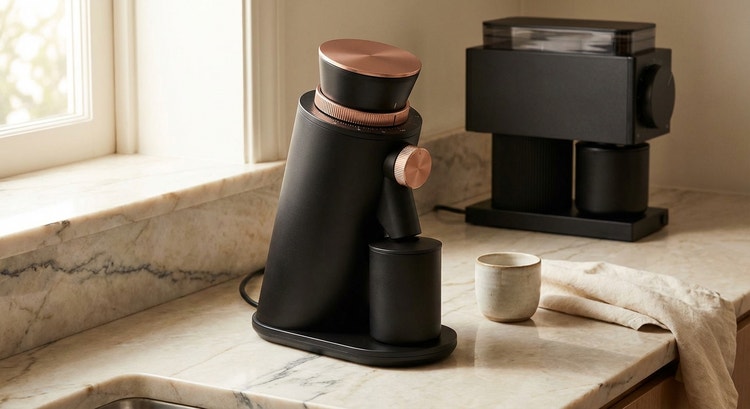
Think of your espresso setup as a signal chain — beans go in, liquid comes out, and every piece of equipment either preserves or degrades the potential locked inside those beans. The grinder is the first active link in that chain, and it determines the upper limit of what every downstream component can achieve. A mediocre grinder paired with a superb machine will produce mediocre espresso. A superb grinder paired with a modest machine will produce surprisingly good espresso. This asymmetry exists because the grinder controls particle size distribution, which is the single largest factor in extraction uniformity. When a grinder produces a wide range of particle sizes — some dust, some boulders — the fine particles over-extract while the coarse ones under-extract, and you end up with a muddled, simultaneously bitter and sour shot no amount of pressure profiling can rescue. A quality grinder narrows that distribution so that water passes through a puck of consistently sized particles, extracting each one at roughly the same rate. The result is a cleaner, sweeter, more articulate shot. The Arco Macinino was designed around this principle: tight tolerances on a 54mm flat burr set that punches well above its price point in particle uniformity tests.
What Makes a Grinder 'Good Enough' for Espresso
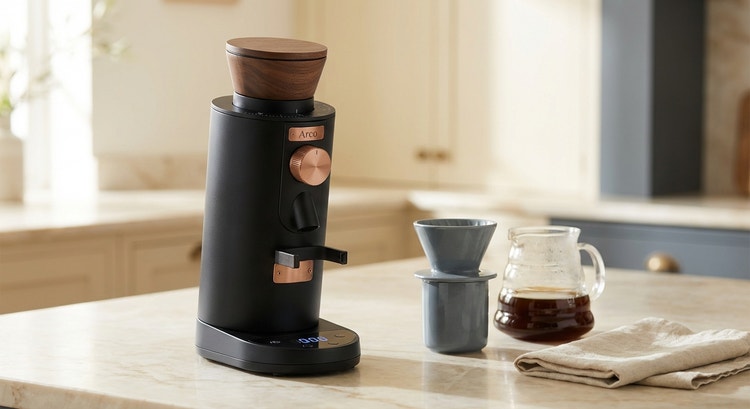
Espresso demands more from a grinder than any other brew method. The target grind size is extremely fine — typically between 200 and 400 microns — and small adjustments of even 10 to 20 microns make a noticeable difference in the cup. That means your grinder needs two things: the ability to produce a narrow particle distribution at fine settings, and the mechanical precision to make repeatable micro-adjustments. Blade grinders fail on both counts. Many entry-level burr grinders clear the first hurdle but stumble on the second — their stepped adjustment mechanisms jump in increments too large for espresso tuning. This is why the Arco Preciso uses a stepless micro-adjustment collar with a visual index ring. You can nudge grind size in fractions of a mark and return to the same setting tomorrow with confidence. Beyond adjustment precision, retention matters. Coffee grounds that stay trapped inside the grinder from one dose to the next are stale by your next session. Low-retention grind paths — short, straight, and gravity-assisted — ensure that what you grind is what ends up in the portafilter. If your current grinder leaves more than a gram of grounds behind, you are starting every shot with a blend of fresh and stale coffee, and no recipe in the world compensates for that.
The Upgrade Math That Nobody Talks About
Here is a thought experiment. You have a budget of six hundred euros to upgrade your setup. Option A: spend it all on a better espresso machine, keeping your current grinder. Option B: split it — three hundred on a capable grinder and three hundred toward a modest machine upgrade or accessories. Nearly every experienced barista and roaster will tell you to take Option B. The reason is diminishing returns. Going from a pressurized-basket entry machine to a proper nine-bar machine with a standard portafilter is a meaningful leap, but going from that machine to one costing twice as much yields a much smaller improvement if your grinder is still producing uneven particles. Conversely, going from a blade or cheap burr grinder to a properly aligned flat-burr espresso grinder is one of the largest single jumps in cup quality you will ever experience. We see this constantly in our training lab: participants bring their own machines but use our Arco Preciso, and the improvement in their shots is immediate and dramatic. The grinder unlocks flavors their machine was always capable of producing — it just never received a puck good enough to show it. Allocate your budget where it matters most, and you will drink better coffee from day one.
Signs Your Grinder Is Holding You Back
If you are unsure whether your grinder is the weak link, watch for these symptoms. First, inconsistency between shots. You follow the same recipe — same dose, same yield, same time — but the flavor swings unpredictably from sour to bitter. That variance almost always traces back to a grinder producing different particle distributions from one dose to the next, often due to loose burr alignment or inconsistent motor speed. Second, channeling. If your bottomless portafilter shows uneven streams, spurts, or blond spots, the puck has weak points created by clusters of fines or pockets of coarse grounds. A better grinder reduces channeling dramatically. Third, a narrow range of acceptable recipes. If you can only get a decent shot within an extremely tight window — say, exactly 18.0 grams in, 36 grams out, in exactly 27 seconds — and anything outside that window tastes bad, your grinder's wide particle distribution is leaving no margin for error. A capable grinder widens the window of good results because extraction is more uniform across a range of parameters. Finally, if adjusting grind by one step on your grinder changes shot time by more than five or six seconds, the steps are too coarse for espresso. You need finer adjustment resolution, and that is exactly what the Arco Macinino and Preciso deliver.
How to Transition Without Wasting Beans
Switching to a new grinder means re-learning your baseline, and the fastest way to do that without burning through a kilogram of beans is structured dial-in. Start with the grinder's recommended espresso range — the Arco Macinino and Preciso both have a marked espresso zone on their adjustment collars. Set it to the middle of that zone, dose your usual amount, and pull a shot. Taste it. If it runs fast and tastes sour, move one increment finer. If it chokes or tastes bitter and ashy, move one increment coarser. Change only one variable at a time and taste every shot rather than watching the clock. Within four or five shots you will be in the neighborhood, and from there, micro-adjustments bring you home. Keep a simple log — dose, grind setting, time, yield, and a one-word flavor note — for your first week. You will build a mental map of how your new grinder responds to different beans. After that initial learning curve, you will find that dialing in new bags takes only two or three shots rather than the six or seven you were used to. A good grinder does not just make better coffee; it makes the process of finding better coffee faster, more predictable, and far less wasteful.
Key Takeaways
- Grind uniformity has a larger impact on shot quality than any single feature of your espresso machine.
- A capable grinder widens the recipe window where espresso tastes good, making dial-in faster and less wasteful.
- Budget allocation should favor the grinder — a great grinder with a modest machine outperforms the reverse.
- Watch for inconsistent shots, channeling, and oversized grind steps as signs your grinder is the bottleneck.
Related Products
Arco Macinino