Sophie Chen, Product Engineer · 8 min read
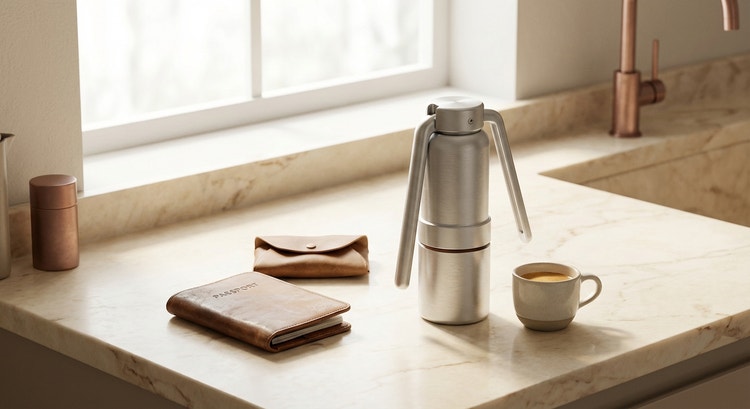
Lena Schäfer sold her apartment in Hamburg, converted a Volkswagen Crafter into a mobile home, and drove south. That was eighteen months ago. She has since brewed espresso on beaches in Portugal, in mountain passes in the Alps, and beside a frozen lake in Norway — always with her Arco Viaggio, a portable lever espresso maker that fits in a shoebox.
Leaving the Kitchen Behind
Lena worked as a UX designer for a digital agency in Hamburg for seven years. Her apartment had a proper kitchen with an Arco Doppio on the counter and a daily ritual she loved. When the pandemic forced remote work, she realized her job did not require a city, an office, or a permanent address. She spent six months converting a van — insulating walls, building a bed platform, installing solar panels and a water system — and gave notice on her apartment. The hardest part of downsizing, she says, was the espresso setup. The Doppio was too large, too power-hungry, and too fragile for life in a vehicle. She considered giving up real espresso entirely and switching to a Moka pot or an AeroPress. Then she found the Arco Viaggio. The Viaggio is a manual lever espresso maker — no electricity, no pump, no boiler. You heat water separately, load the grounds, and press a lever that generates up to nine bars of pressure through a precision piston and cylinder. It weighs 680 grams, packs into a padded case the size of a hardcover book, and produces genuine espresso anywhere you can boil water. Lena tested it in her apartment before leaving and was shocked by the shot quality — thick crema, syrupy body, and a flavor complexity that rivaled her Doppio when she dialed it in.
Brewing on the Road
Lena's morning routine on the road is simple but deliberate. She wakes with the light — no alarm — slides open the van's side door, and sets up on the fold-out table attached to the van's exterior. She boils water on a small butane stove, grinds beans with a hand grinder, and loads the Viaggio's portafilter basket. The lever press takes about twenty seconds of sustained, even pressure. She watches the espresso emerge from the bottom of the cylinder into an enamel cup and stops when the color lightens. Total brew time from waking to first sip is about eight minutes, most of which is waiting for water to boil. The quality varies more than it did with the Doppio, because manual lever brewing is more technique-dependent than pump machines. Pressure is generated by her hands, not a motor, so consistency depends on the steadiness and speed of her press. In the early weeks, her shots were erratic — fast one day, choked the next. She learned to feel the resistance through the lever and modulate her force accordingly. After about three weeks, her shots stabilized. She now dials in a new bag within two or three shots, the same as she did on the Doppio. The biggest variable is water temperature. Without a thermometer in the early days, she was guessing. A small digital thermometer clipped to her pour kettle solved the problem — she targets 93 degrees Celsius for most beans.
The Places and the People
The Viaggio has been to places no espresso machine was designed to visit. Lena has brewed on a cliff overlooking the Atlantic in the Algarve, in a campground near Chamonix at 1,200 meters elevation, on a ferry crossing from Denmark to Sweden, and in a parking lot outside a supermarket in rural Norway where the temperature was minus twelve Celsius and the water in her tank had frozen overnight. That last one required melting snow on the stove — she describes the resulting espresso as surprisingly clean-tasting, which makes sense given the low mineral content of snow melt. The machine has also been a social catalyst. Van life can be solitary, and Lena is an introvert by nature. But pulling espresso at a campsite invariably draws curious neighbors. She has served shots to a retired Dutch couple in their motorhome, a group of Portuguese surfers, a family of Italian campers who critiqued her technique with affectionate authority, and a Norwegian fisherman who declared it the best coffee he had tasted since his wife stopped making it. Each encounter was brief but genuine — the kind of spontaneous human connection that a shared experience of something good tends to produce. She keeps a small journal where she notes the location, the beans, and the person she shared espresso with. It is becoming her favorite record of the trip.
What Espresso Means Without a Home
When you live in a van, home is not a place — it is a set of rituals that travel with you. Lena describes espresso as the most anchoring of her portable rituals. The morning routine is identical whether she is parked on a Sardinian beach or in a Scandinavian forest: boil water, grind, press, sip. The consistency of the process creates a sense of normalcy that the changing landscape cannot provide. Without it, mornings feel untethered. The Viaggio has also changed how she thinks about equipment. In her apartment, she valued features — PID control, pre-infusion settings, steam power. On the road, she values simplicity, reliability, and the absence of electricity dependency. The Viaggio has no circuit board to fail, no pump to burn out, no electronics to corrode in humid coastal air. It is a piston in a cylinder, pushed by a lever. If it breaks — and in eighteen months of daily use it has not — the parts are mechanical and replaceable with basic tools. She does not romanticize van life. It is often cold, cramped, and logistically exhausting. But the espresso is real, and in a life defined by impermanence, that small consistency matters more than she expected it to. The best machine, she says, is not the one with the best specifications. It is the one that is with you when you need it.
Key Takeaways
- The Arco Viaggio produces genuine espresso without electricity — a manual lever generating up to nine bars of pressure through a precision piston.
- Consistent technique develops within a few weeks of daily use; a small thermometer solves the water temperature variable.
- Portable espresso becomes a social catalyst on the road, creating spontaneous connections with fellow travelers.
- In a life without a fixed home, a consistent morning ritual provides the anchoring that a changing landscape cannot.
Related Products