Priya Sharma, Customer Care Lead · 8 min read
Kenji Matsuda is the operations manager at a thirty-person fintech startup in Amsterdam's Jordaan district. When the company moved into a new office, he was handed an unexpected brief: replace the capsule machine. The team had outgrown it in every sense. What followed was a surprisingly rigorous procurement process that ended with an Arco Ufficio and a complete rethinking of how the office relates to coffee.
The Problem with the Capsule Machine
The old setup was a high-end capsule machine — the kind with a touchscreen, a milk frother, and a branded capsule subscription. It was fine when the company was twelve people. At thirty, it was failing. The capsule bin filled up twice a day. The milk frother broke every few weeks and took days to get serviced. The capsules themselves generated an absurd volume of aluminium waste that no one in the office felt good about. And frankly, the coffee was mediocre — every cup tasted the same regardless of which capsule you chose, and the milk drinks were lukewarm and foamy in the wrong way. Kenji surveyed the team and discovered that fourteen of the thirty employees were buying coffee from the specialty shop two blocks away, spending four to five euros per cup, two or three times a day. The company was spending eighteen hundred euros a year on a capsule subscription, and the team was spending significantly more at the shop down the street. The math was clear: a better in-house coffee solution would pay for itself within months, improve morale, and eliminate the waste stream. Kenji presented the case to the founders, who gave him a budget and a directive: find something good, keep it simple, and make sure it does not become someone's second job to maintain.
Why the Arco Ufficio
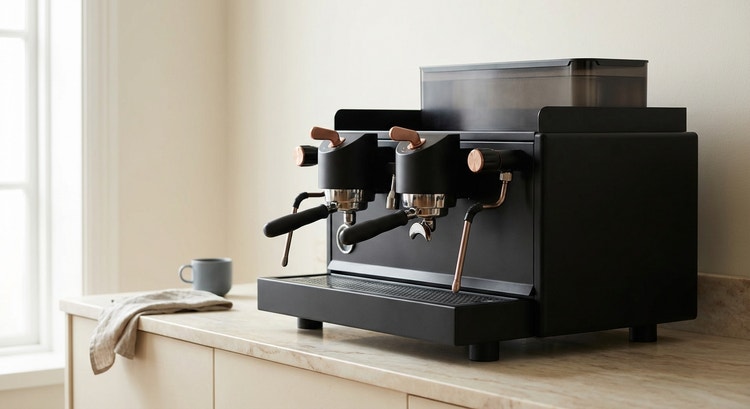
Kenji researched office espresso machines for three weeks. He visited two showrooms, read equipment forums, and called Arco's commercial team for a consultation. His requirements were specific: the machine needed to produce genuine espresso and steamed milk for a team of thirty pulling between forty and sixty cups a day. It needed to be intuitive enough that anyone could use it without training. It needed to be maintainable with a simple daily cleaning routine rather than requiring a service contract. And it needed to look good in a design-conscious office. The Arco Ufficio met every criterion. It is a dual-boiler machine with a plumbed water connection and an automatic shot dosing system — the user selects single or double, and the machine doses by weight, tamps with an integrated piston, and pulls the shot to a pre-set yield. Milk steaming is semi-automatic with a rotary dial that controls steam flow. The machine handles the precision; the user handles the creative part. The commercial-grade build means it can sustain the volume without overheating or dropping pressure between shots. Kenji paired it with an Arco Preciso grinder set to a single espresso setting, so the team does not need to adjust grind throughout the day. He sourced a standing order from a local Amsterdam roaster — a rotating blend designed for milk drinks and a single-origin for straight espresso — and set up a simple cleaning schedule.
The First Week and the Culture Shift
The Ufficio arrived on a Monday. Kenji spent the first morning demonstrating the workflow to clusters of curious colleagues. By Tuesday, three team members were pulling their own shots confidently. By Friday, fourteen people who had been buying coffee down the street were making it in the office. The quality was the driver — the Ufficio pulls shots that are genuinely good, not office-good, and the difference from the capsule machine was obvious to everyone, including people who claimed they could not taste the difference between instant and espresso. The cultural impact surprised Kenji more than the financial savings. The coffee station became a gathering point. People who worked on different floors started converging in the kitchen at predictable times — mid-morning, after lunch, mid-afternoon — and conversations happened that would not have happened otherwise. A developer and a compliance officer who had never spoken discovered a shared interest in cycling while waiting for milk to steam. Two designers started a weekly espresso tasting session on Friday afternoons, bringing in different beans and blind-cupping them. The machine created social infrastructure that Kenji's operations spreadsheet had not anticipated. The founders noticed. One of them told Kenji it was the best operational investment the company had made since buying standing desks.
Maintenance and the Long Game
Kenji's biggest concern before purchasing was maintenance. The capsule machine had required frequent service calls, and he did not want to replace one maintenance headache with a larger one. In practice, the Ufficio has been remarkably low-maintenance. The daily routine takes five minutes: backflush the group with water, wipe the steam wand, empty the drip tray, and refill the bean hopper. Once a week, Kenji runs a detergent backflush and soaks the shower screen — a ten-minute task he does on Monday mornings before the rush. The plumbed water connection runs through an inline filter that Kenji replaces every three months. The machine prompts descaling every eight weeks based on shot count, and the process is semi-automated — press the descale button, add the solution, and the machine runs itself through the cycle. In six months, the Ufficio has had zero breakdowns and zero service calls. Kenji estimates the total cost of ownership — machine, grinder, beans, filters, and cleaning supplies — at about forty cents per cup. The capsule machine was running at sixty-five cents per cup, and the specialty shop down the street charges four-fifty. The team now drinks roughly fifty cups a day in the office, and the shop visits have dropped to occasional treat outings rather than daily necessities. The waste stream is a fraction of the capsule era: compostable coffee grounds go in the organic bin, and the only packaging is the recyclable bean bags.
Key Takeaways
- The Arco Ufficio replaced a capsule machine for a thirty-person office, cutting per-cup costs from sixty-five cents to forty and eliminating capsule waste.
- Automatic dosing and tamping make the machine usable by anyone without training; semi-automatic milk steaming adds a creative element.
- The coffee station became unexpected social infrastructure, generating cross-team conversations and a Friday tasting ritual.
- Daily maintenance takes five minutes; six months in, the machine has required zero service calls.
Related Products