Elena Marchetti, Head of Product · 9 min read
Giuliana Rossi taught mathematics at a liceo in Parma for thirty-four years. When she retired at sixty-two, she expected to fill her mornings with gardening and crossword puzzles. Instead, she fell into the world of specialty espresso and has spent the last three years methodically mastering it. We sat at her kitchen table while she pulled shots and explained how the same discipline that structured a classroom now structures her coffee routine.
A Retirement Without a Plan
Giuliana's retirement began the way many do — with relief followed quickly by restlessness. After three decades of waking at six, marking papers until midnight, and managing classrooms of thirty teenagers, the sudden absence of structure was disorienting. She gardened. She read. She visited her daughter in Rome. But by the third month, she was looking for something to learn, because learning, she says, is the thing she is best at and the thing she missed most. The catalyst was not dramatic. Her son-in-law, a food writer based in Naples, gave her a bag of single-origin coffee beans as a birthday gift along with a handwritten note explaining how to brew them. She had been drinking espresso from a stovetop Moka pot her entire life — the same Bialetti her mother had used — and had never considered that the beans themselves could taste different from one another. She brewed the gift beans in the Moka pot and tasted something unfamiliar: a bright, almost citrusy note she had never encountered in decades of Italian espresso. She called her son-in-law and asked what was happening. He laughed and said she had just discovered specialty coffee. He suggested she visit a local roaster in Parma who held weekly tasting sessions. She went the following Saturday and has not stopped since.
Approaching Espresso Like a Syllabus
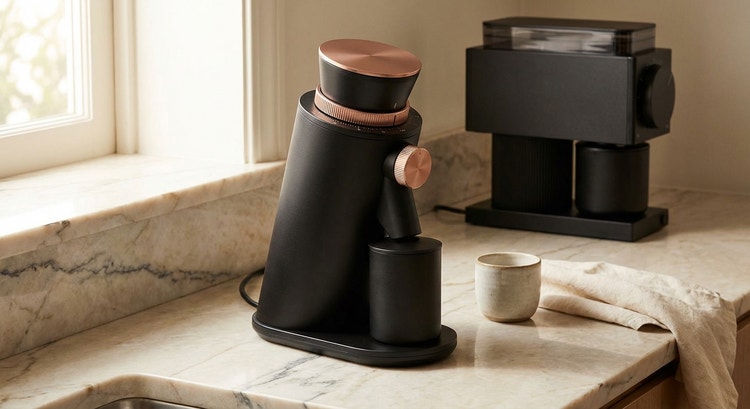
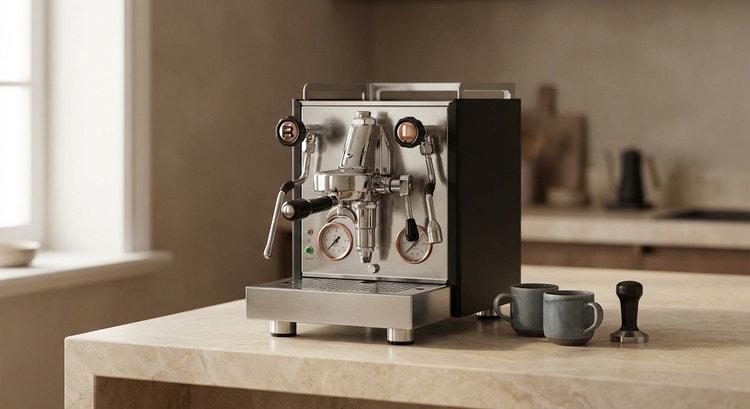
Giuliana's approach to learning espresso was unmistakably that of a teacher. She created a structured curriculum for herself, divided into units the way she would have organized a school year. Unit one was coffee origins — she spent a month reading about growing regions, processing methods, and how geography and climate influence flavor. Unit two was extraction theory — she studied how water temperature, pressure, grind size, and contact time interact to pull soluble compounds from ground coffee. Unit three was equipment — she researched machines and grinders with the same rigor she once applied to selecting textbooks, reading specifications, comparing reviews, and visiting shops to see the machines in person. She chose the Arco Doppio because its dual-boiler design meant she could brew espresso and steam milk simultaneously without temperature compromises, and because the PID controls gave her the kind of precise, repeatable parameters she values. She paired it with the Arco Preciso grinder after reading that stepless adjustment was essential for espresso-level precision. Her kitchen notebook — a hardcover Moleskine — contains dated entries for every shot she has pulled in three years. Each entry records the bean, roast date, grind setting, dose, yield, time, water temperature, and a tasting note. There are over two thousand entries. When she switches to a new bag of beans, she reviews previous entries for that origin to establish a starting point. It is, she admits, the behavior of someone who spent a career grading homework.
The Ritual That Replaced the Routine
Teaching had given Giuliana's mornings a rigid structure: wake, dress, commute, teach. Retirement removed that structure, and for the first few months she drifted. Espresso gave it back. Her morning now follows a sequence she describes as meditative. She wakes at six — the same time as her teaching years, because decades of habit do not dissolve — and begins by selecting beans. She keeps three to four open bags at any time, stored in vacuum canisters on a shelf above the machine, each labeled with origin, roaster, and roast date. She chooses based on mood, which she says is the one variable she allows herself that is not quantifiable. She doses eighteen grams into the portafilter, grinds, distributes with a WDT tool her son-in-law made from a wine cork and acupuncture needles, tamps, and locks in. The Doppio's dual boiler means the brew boiler and the steam boiler are both at temperature by the time she is ready. She pulls the shot into a pre-warmed ceramic cup — always ceramic, never glass, because she says the thermal mass keeps the espresso at drinking temperature longer. She tastes the shot standing at the counter. If it is good, she nods and carries it to the kitchen table where the newspaper waits. If it is not, she adjusts and pulls another. The whole process takes about twelve minutes, and she says those twelve minutes are the most focused part of her day — a sequence of small, precise actions that demand full attention and reward it with something tangible.
What Teaching Taught Her About Coffee
When we asked Giuliana whether her teaching background influenced her approach to coffee, she thought for a moment and then listed three connections. First, patience with the learning curve. She spent thirty-four years watching students struggle with concepts before understanding them, and she knew that mastery of any skill requires a period of productive failure. When her early shots were terrible, she did not feel discouraged — she felt like a student in week one of a new course, exactly where she was supposed to be. Second, the value of systematic observation. In mathematics, you do not solve a problem by guessing randomly; you change one variable, observe the result, and adjust. She applied the same method to dialing in: change the grind by one increment, taste, record, adjust. Never change two things at once. Her notebook is the espresso equivalent of showing your work. Third, the importance of fundamentals. She says the worst students were always the ones who wanted to skip ahead to advanced topics without mastering the basics. In espresso, the basics are consistent dosing, even distribution, level tamping, and stable temperature. She spent her first three months focused exclusively on those four things before she began experimenting with different beans, ratios, or temperatures. By the time she started exploring, her technique was solid enough that she could actually taste the differences rather than drowning them in noise from sloppy preparation.
A New Kind of Classroom
Giuliana's espresso hobby has unexpectedly returned her to teaching. Her neighbors in the apartment building learned about her setup and began asking questions. One asked for help choosing a machine. Another asked if she could show him how to use his new grinder. Before long, she was hosting what she calls Saturday morning lab sessions — informal gatherings of three or four neighbors in her kitchen, where she walks them through the basics of espresso preparation on her Doppio. She does not charge anything and insists on providing the beans. The sessions follow a loose structure: she demonstrates a concept, then each person practices while she observes and offers corrections. It is, by her own admission, a classroom. She has even caught herself saying things like 'pay attention, this will be on the test' before laughing at the habit. Two of her regular students have since bought their own Arco machines — a Primo and a Nano — and she helps them dial in new beans over the phone, talking them through adjustments the way she once walked students through quadratic equations. Her daughter jokes that she did not retire from teaching; she just changed the subject. Giuliana does not disagree. She says the fundamental joy is the same: watching someone go from confusion to comprehension, from a bad shot to a good one, and knowing that a small amount of guidance made the difference.
Key Takeaways
- Retirement created space for a new discipline, and espresso provided the structure and focus Giuliana missed from teaching.
- A systematic approach — changing one variable at a time and recording every result — accelerates learning and builds durable skill.
- Mastering the fundamentals of dose, distribution, tamp, and temperature before exploring advanced techniques builds a stable foundation.
- Sharing knowledge with others is its own reward, whether the subject is mathematics or extraction.
Related Products
Arco Doppio