Marcus Webb, Barista Trainer · 7 min read
Ravi Kapoor works twelve-hour shifts in the pediatric intensive care unit at a London teaching hospital. His alarm goes off at 5:15 AM, and by 5:45 he is standing in his kitchen in Bethnal Green pulling a shot on his Arco Nano. That espresso is the only predictable, unhurried moment in a day that belongs entirely to other people's needs.
The Machine That Fits the Life
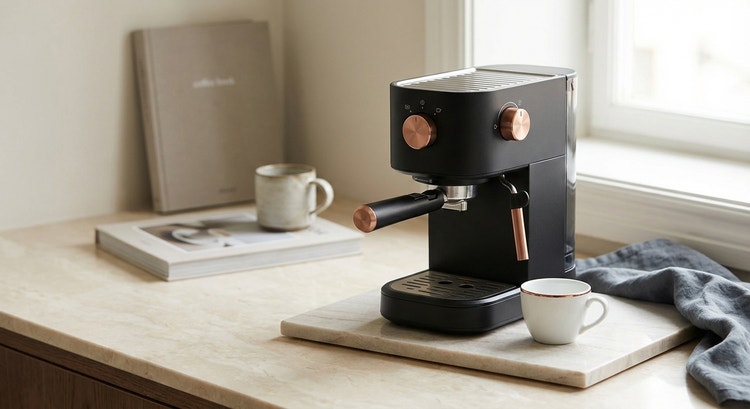
Ravi's kitchen is small by any standard — a narrow galley in a Victorian conversion that barely fits two people standing side by side. Counter space is measured in centimeters, not meters. When he decided to invest in a real espresso machine, size was the first constraint. He needed something that could sit permanently on the counter without blocking the toaster or the kettle, because his flatmate uses both every morning and would not tolerate a counter takeover. The Arco Nano fit the brief. At 20 centimeters wide and 28 centimeters deep, it occupies less space than a breadbox. Ravi keeps it in the corner beside the tile backsplash, its matte grey finish blending into the kitchen without announcing itself. Despite its size, the Nano produces genuine espresso through a standard 54mm portafilter — smaller than the 58mm used on larger machines, but compatible with quality baskets and accessories. The thermoblock heats in under a minute, which matters when your morning routine is measured in single-digit minutes. Ravi chose it over the Primo because the Primo's slightly larger footprint would have pushed the kettle off the counter, and over a capsule machine because he found capsule espresso thin and one-dimensional after tasting real espresso at a colleague's house.
The 5:45 Ritual
Ravi's alarm goes off at 5:15. He showers, dresses, and is in the kitchen by 5:40. The Nano goes on first — power button, wait for the light. While it heats, he grinds a dose using a hand grinder — a small ceramic burr model he chose because it is silent enough not to wake his flatmate through the thin walls. He grinds 16 grams, doses into the portafilter, tamps with a quick press, and locks in. By 5:45, the shot is pulling. He watches it for thirty seconds, stops the pump, and drinks standing at the counter. The whole process takes about four minutes. There is no milk, no sugar, no elaborate latte art. Just espresso in a small ceramic cup, consumed in silence while the city outside is still dark. He rinses the portafilter, wipes the drip tray with a cloth, and is out the door by 5:55 for the fifteen-minute cycle to the hospital. He describes the ritual as the only part of his day that is entirely under his control. Once he arrives on the ward, his time belongs to his patients, their families, and the unpredictable rhythms of intensive care. The espresso is his — a small, private act of attention to quality that anchors the rest of the day.
Why Quality Matters When Time Is Short
Before the Nano, Ravi drank instant coffee. He is not embarrassed about this — he was a student, then a junior nurse working nights, and caffeine was a utility, not a pleasure. The shift happened when a senior colleague, a consultant anesthesiologist who had been making espresso for twenty years, invited the ward team to his house for lunch. He served espresso from a large Italian machine, and Ravi was startled by how different it tasted from everything he had called coffee before. It was sweet, dense, and complex — nothing like the bitter, one-note drink he associated with the word. He asked questions, tasted more, and left with the realization that the difference between bad coffee and good coffee was not subtle — it was a different experience entirely. Over the following months, he researched machines, read forums, and gradually built his setup. The hand grinder came first — grinding fresh beans into his Moka pot transformed his morning coffee overnight. The Nano came six months later, and with it, the pressure and temperature control that a stovetop cannot provide. Ravi is the first to say he is not a coffee enthusiast in the way that forum regulars are. He does not weigh his shots or log extraction times. But he cares about quality in the cup, and the Nano delivers it within the constraints of his life — small, fast, and genuinely good.
The Other Side of the Shift
When Ravi gets home after a twelve-hour shift — usually around 8:30 in the evening — he does not make espresso. He is too tired, and caffeine at that hour would ruin the sleep he desperately needs. Instead, he makes a decaf pour-over using a simple ceramic dripper and pre-ground decaf from a London roaster. It is a slower, gentler process than the morning espresso — no machine, no pump noise, just hot water and gravity. He drinks it at the kitchen table while eating dinner, often alone because his flatmate keeps different hours. The contrast between the two rituals mirrors the contrast between the two halves of his day. The morning espresso is quick, focused, and preparatory. The evening pour-over is slow, reflective, and restorative. He needs both. On his days off — he works three or four shifts per week — the morning routine changes. He sleeps until eight, makes espresso at a leisurely pace, sometimes pulling two or three shots while reading the news on his phone. The Nano gets a proper cleaning on these mornings — backflush, wipe down, rinse. It is the maintenance day. He says the machine asks so little of him during the week that giving it attention on his day off feels like a fair exchange. The Nano is not the center of his life. It is a small, reliable presence in a life that demands reliability above all else.
Key Takeaways
- The Arco Nano's compact footprint and fast heat-up make it viable for small kitchens and compressed morning routines.
- Ravi's four-minute morning ritual is the only fully controllable moment in a twelve-hour shift spent responding to others' needs.
- The shift from instant coffee to real espresso was triggered by a single experience of quality — the gap is not subtle, it is a different category.
- A machine does not need to be the center of your life to meaningfully improve your daily experience.
Related Products