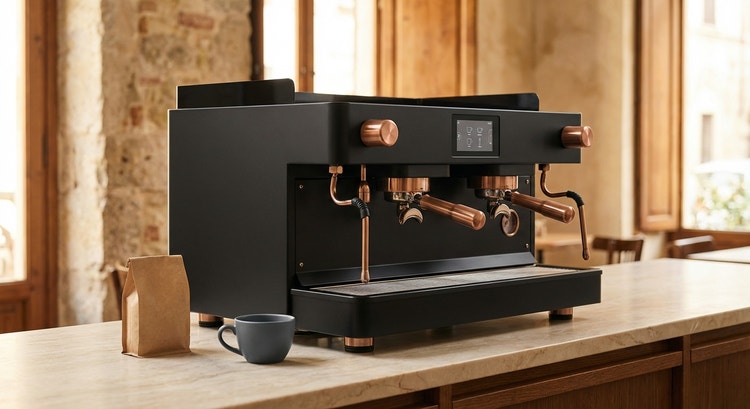
The Story of the E61 Group Head: History, Relevance, and Why Arco Still Believes in It
Elena Marchetti, Head of Product · 10 min read
In 1961, Ernesto Valente of FAEMA introduced a group head design so elegant and effective that it is still manufactured and used in both commercial and home machines more than sixty years later. The E61 group head is the most enduring piece of espresso engineering ever created. Here is its story, why it works, and what Arco has done with it.
Milan, 1961: A Revolution in a Brass Casting
Before the E61, espresso machines used lever-actuated or spring-loaded pistons to force water through coffee. These machines required physical effort from the barista and produced inconsistent results — each pull depended on the operator's strength and timing. Ernesto Valente's breakthrough was replacing the manual lever with an electric pump and designing a group head that incorporated thermosyphon heating and a built-in pre-infusion mechanism. The E61 — named after the June 1961 total solar eclipse that coincided with its release — used a heavy chromed-brass body with an internal channel that allowed water from the boiler to circulate continuously through the group via natural convection. This thermosyphon loop kept the group head at a stable temperature without electrical heating elements, timers, or electronic controls. The pre-infusion chamber, built into the group itself, allowed a small volume of water to contact the coffee puck at reduced pressure before the full pump pressure engaged. It was remarkably sophisticated for its era and solved multiple problems simultaneously: temperature stability at the brew point, mechanical pre-infusion for better extraction, and a standardized design that simplified maintenance and parts availability across manufacturers. Within a decade, the E61 became the default group head for quality espresso machines worldwide.
Why the Design Has Endured
The longevity of the E61 is not nostalgia — it is physics. The thermosyphon heating principle is inherently stable. As long as the boiler maintains temperature, the circulating water keeps the brass group body at a consistent brew temperature with no electronic intervention. There are no temperature sensors to fail, no heating elements to burn out, and no software to glitch. The thermal mass of the brass body acts as a buffer, absorbing momentary fluctuations and delivering remarkably even heat to the puck across consecutive shots. The mechanical pre-infusion works reliably because it is passive — it relies on the physical dimensions of the chamber and the spring tension on the group valve, not on electronics. This makes it self-correcting in a way that programmed pre-infusion cannot be: the water finds its own equilibrium with the puck resistance before full pressure is applied. The E61 is also an open standard. Because FAEMA did not aggressively patent the design and because it became so widely adopted, a vast ecosystem of compatible parts exists. Portafilters, baskets, screens, and gaskets are interchangeable across hundreds of machines from dozens of manufacturers. For the end user, this means readily available replacement parts and accessories for decades after purchase — a practical benefit that no proprietary design can match.
How Arco Implements the E61
When we designed the Arco Studio and Studio Pro, we started with the E61 group as a non-negotiable foundation. Not because tradition demanded it, but because no alternative offered a better combination of thermal stability, serviceability, and user experience for the segment we were designing for. That said, we did not simply bolt a stock E61 casting onto our machines and call it done. Arco's implementation uses a custom-machined brass group body with tighter tolerances than off-the-shelf castings. The internal thermosyphon channels are polished to reduce flow resistance, which improves heat circulation at idle and shortens the time to thermal equilibrium after back-to-back shots. We widened the pre-infusion chamber slightly and added a user-accessible adjustment screw that lets you modify the pre-infusion dwell time without disassembling the group — a feature that enthusiasts appreciate and that is unique to Arco's implementation. The Studio Pro goes further by adding a temperature sensor at the puck face — not to control the group electronically, but to provide real-time feedback via the display. You can see the exact temperature at the point of extraction, monitor shot-to-shot consistency, and make informed boiler adjustments. It is digital intelligence overlaid on an analog foundation, and it gives you the best of both approaches.
The E61 in a World of Saturated Groups
In recent years, some manufacturers have moved toward saturated group designs, where the group head is machined directly from the boiler or bolted to it with no thermosyphon loop. Saturated groups offer slightly faster heat-up and marginally tighter temperature control because the group is in direct thermal contact with the boiler. These are genuine advantages, and we respect the engineering. But they come with trade-offs. Saturated groups are manufacturer-specific — proprietary castings that require proprietary parts. They are harder to service at home because removing the group means disconnecting it from the boiler. And their tight coupling to the boiler means that any boiler temperature fluctuation is immediately transmitted to the group, with no thermal mass buffer to smooth it out. The E61's thermosyphon loop acts as a low-pass filter for temperature noise. Brief boiler fluctuations are absorbed by the massive brass body before they reach the puck. For home users who may not have laboratory-grade temperature controllers, this passive stability is genuinely valuable. We chose the E61 not out of conservatism but out of conviction. It is a design that rewards understanding, invites tinkering, and delivers exceptional espresso when paired with a well-designed boiler and a capable grinder. Sixty years from now, someone will still be pulling beautiful shots through a brass E61.
Key Takeaways
- The E61 group head, introduced in 1961, solved temperature stability and pre-infusion with an elegant thermosyphon design that requires no electronics.
- Its endurance stems from physics — passive thermal stability, mechanical pre-infusion, and an open-standard parts ecosystem.
- Arco's implementation uses custom-machined brass with polished thermosyphon channels and a user-adjustable pre-infusion dwell screw.
- The E61 remains a compelling choice over saturated groups for home users who value serviceability, parts availability, and passive temperature buffering.
Related Products
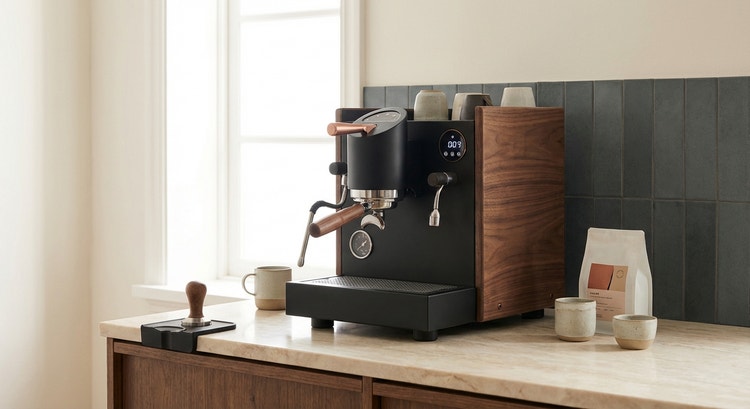
Arco Studio